“Behind the Eye” EP 03 Dehancer film emulation
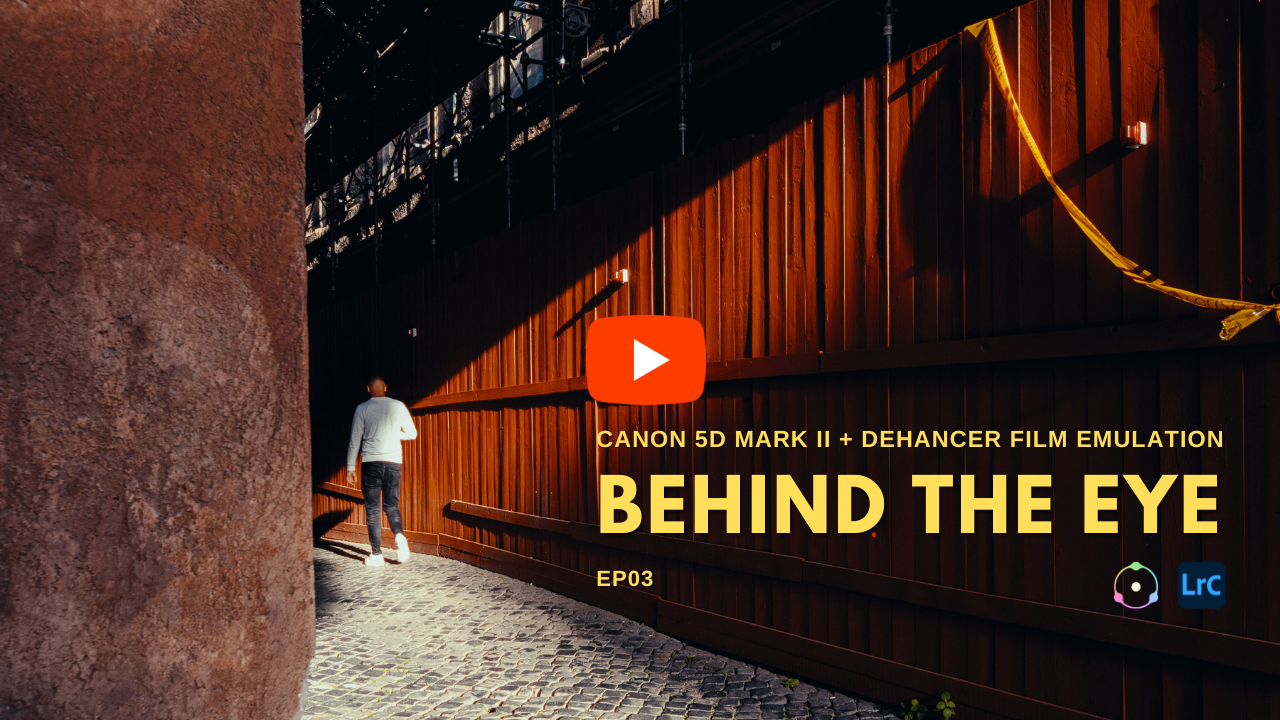
Negli ultimi anni il confine tra fotografia analogica e digitale si è fatto sempre più sottile. Non tanto per una questione tecnica, quanto per un’esigenza espressiva: ritrovare nel digitale una memoria visiva credibile, fatta di colore, grana e risposta tonale coerente con l’esperienza sul campo. Per questo ho deciso di realizzare un test reale di Dehancer for Lightroom, durante una sessione di street photography nel centro di Roma, lavorando come faccio sempre: camminando, osservando e lasciando che siano le condizioni reali a guidare le scelte.
Questo non è un tutorial, ma un test sul campo vero e proprio.
Per questo lavoro ho volutamente scelto di uscire dalle mie abitudini. Niente pellicola, niente bianco e nero. Ho utilizzato una Canon 5D Mark II, una reflex digitale che non usavo da tempo, ma che ancora oggi restituisce un file equilibrato, lavorabile e privo di quell’eccesso di densità di pixel tipico dei sensori più moderni. Come ottica ho montato un 16–35mm, utilizzandolo però fisso a 24mm per tutta la giornata. Una scelta consapevole, per mantenere coerenza di visione e ritmo nello scatto. La macchina si è rivelata più ingombrante rispetto ai corpi compatti a cui sono abituato, ma il feeling con il mirino ottico è stato immediato. Guardare dentro un mirino reale, e non digitale, riattiva un rapporto fisico con l’immagine che avevo quasi dimenticato.
Il percorso si è sviluppato tra Colosseo, Via dei Fori Imperiali e Altare della Patria. In questo periodo dell’anno la luce a Roma è particolarmente interessante: morbida, ma allo stesso tempo molto tagliente, con forti contrasti e riflessi continui su marmo, asfalto e superfici chiare. Ho concentrato la mia attenzione su: contrasti di colore, transizioni luce/ombra e rapporti tra soggetto e sfondo Tutti elementi fondamentali per valutare come un file digitale reagisce in fase di post produzione, soprattutto quando si lavora con simulazioni pellicola.
Una volta rientrato in studio, ho importato i file in Adobe Lightroom e iniziato il lavoro con Dehancer for Lightroom. La prima cosa che ho apprezzato è stata la semplicità del flusso: l’interfaccia è chiara, diretta, pensata per lavorare sull’immagine senza distrazioni. Un aspetto molto interessante è la presenza di profili già pronti, sviluppati sia dal team Dehancer sia dalla community, che permettono di ottenere risultati estremamente convincenti con interventi minimi. In diversi casi, la simulazione scelta era già praticamente definitiva.
Da direttore della fotografia e fotografo, quello che cerco sempre sia nel cinema che nella fotografia è coerenza, coerenza tra ciò che vedo sul campo e ciò che restituisco in post produzione. Dehancer non lavora come un semplice filtro, ma come uno strumento di interpretazione dell’immagine. Permette di costruire una continuità visiva credibile, soprattutto quando si lavora su progetti fotografici strutturati o su più sessioni.
Se vuoi provare Dehancer , puoi utilizzare il codice sconto: 👉 NACCIA10 — 10% di sconto su Dehancer
ENG
In recent years, the boundary between analog and digital photography has become increasingly thin. Not so much for technical reasons, but for an expressive need: rediscovering, within digital images, a credible visual memory made of color, grain, and a tonal response consistent with real-world experience. For this reason, I decided to carry out a real-world test of Dehancer for Lightroom during a street photography session in the center of Rome, working as I always do: walking, observing, and letting real conditions guide my choices.
This is not a tutorial, but a true field test.
For this project, I deliberately chose to step outside my usual habits. No film, no black and white. I used a Canon 5D Mark II, a digital SLR I hadn’t used in quite some time, but one that still delivers a balanced, flexible file, free from the excessive pixel density typical of more modern sensors. As a lens, I mounted a 16–35mm, but kept it locked at 24mm for the entire day. A conscious decision, aimed at maintaining consistency in vision and rhythm while shooting. The camera proved to be bulkier than the compact bodies I’m used to, but the feeling with the optical viewfinder was immediate. Looking through a real viewfinder, rather than a digital one, reactivates a physical relationship with the image that I had almost forgotten.
The route developed between the Colosseum, Via dei Fori Imperiali, and the Altare della Patria. At this time of year, light in Rome is particularly interesting: soft, yet at the same time very sharp, with strong contrasts and continuous reflections on marble, asphalt, and bright surfaces. I focused my attention on color contrasts, light/shadow transitions, and the relationship between subject and background—elements that are fundamental when evaluating how a digital file responds in post-production, especially when working with film simulations.
Once back in the studio, I imported the files into Adobe Lightroom and began working with Dehancer for Lightroom. The first thing I appreciated was the simplicity of the workflow: the interface is clear and direct, designed to work on the image without distractions. A particularly interesting aspect is the presence of ready-made profiles, developed both by the Dehancer team and by the community, which allow for extremely convincing results with minimal intervention. In several cases, the chosen simulation was already very close to final.
As a director of photography and photographer, what I constantly seek—both in cinema and photography—is coherence: coherence between what I experience in the field and what I deliver in post-production. Dehancer does not work like a simple filter, but as an image interpretation tool. It allows you to build a credible visual continuity, especially when working on structured photographic projects or across multiple sessions.
If you’d like to try Dehancer, you can use the discount code: 👉 NACCIA10 — 10% off Dehancer